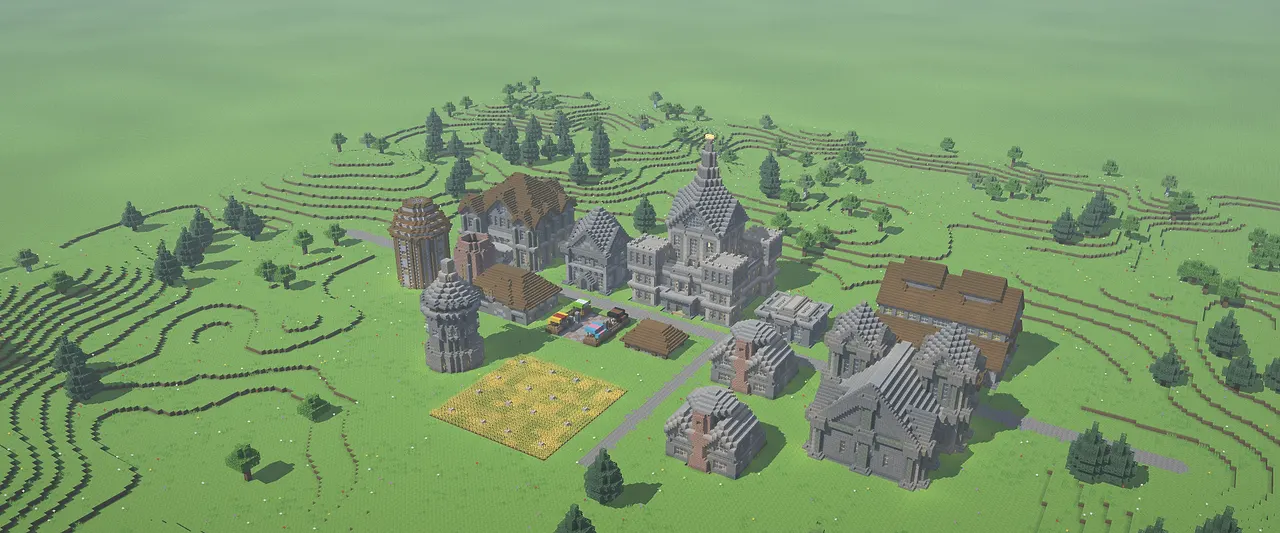
A town is a piece of protected land with a Town Hall or Capitol in the middle. This chapter is about running it: who may do what, how you grow and what it costs.
Who is who
A town has three fixed groups.
- Mayors run the town: claiming, building, taxes, the treasury, residents.
- Assistants may do almost everything a mayor may, except take coins out of the treasury.
- Residents are all the people of the town.
Above that, a civilization has leaders and advisers. They decide on research, government, civ taxes and diplomacy.
/town group add <name> assistantsmakes someone an assistant.removetakes them out./town group new <group>creates a group of your own, for builders for example./civ group add <name> advisersmakes someone an adviser;leadersmakes them a co-leader./town group infoand/civ group infoshow who is in what.
Residents
/town add <name>invites someone. They answer with/acceptor/deny./town memberslists all residents./town evict <name>removes a resident. Mayors and assistants cannot be evicted./town leaveleaves the town. The only mayor cannot leave.
Someone in a camp has to leave it first. Someone who switches civ has to wait 24 hours before joining another. You cannot invite anyone during WarTime.
If no mayor has been online for 7 days, a resident can take over the town with /town claimmayor. For a civ without an active leader there is /civ claimleader.
Claiming land
/town claim claims the chunk you are standing in. That only works when:
- the chunk is inside your culture border;
- the chunk touches land the town already owns;
- the town still has chunks left at its level;
- the treasury can pay the price.
The price per chunk and the maximum depend on the town level, see the table further down. /town unclaim gives a chunk back, without a refund.
Plots and permissions
Each claimed chunk is a plot. A plot has four permissions:
- build: placing blocks;
- destroy: breaking blocks;
- interact: using doors, buttons and chests;
- itemuse: using items, such as buckets.
Each permission is on or off for three parties: the owner of the plot, the group attached to the plot, and others. By default owner and group may do everything and others nothing. A new plot is attached to the residents group, so all residents may build there.
/plot infoshows the owner, the groups and the permissions./plot perm set build others onlets everyone build on this plot. The other permissions and parties work the same way./plot setowner <name>gives the plot to a resident;noneremoves the owner./plot addgroup <group>and/plot removegroup <group>decide which groups count./plot fs <price>puts the plot up for sale,/plot nfstakes it off the market,/plot buybuys it./plot toggle mobsand/plot toggle fireturn monsters and fire spread on or off.
With /res friend add <name> you give a friend the same permissions as yourself on all your plots.
Treasury and taxes
The town treasury pays for claims, structures, upgrades and upkeep.
/town deposit <amount>deposits coins. Any resident can./town withdraw <amount>takes coins out. Mayors only./town infoshows the balance, the upkeep and the price of the next chunk.
A town can tax its residents. The tax goes to the treasury once a day.
/town set taxrate <percent>: a percentage of the value of the plots a resident owns./town set flattax <amount>: a fixed amount per resident.
Mayors and assistants pay no tax. Someone who cannot pay goes into debt and is removed from the town after 3 days. /res paydebt pays off your debt.
Shop structures charge a fee to people from outside the town. Set it with /town set bankfee, storefee, grocerfee, libraryfee or blacksmithfee, between 5 and 15 percent.
Upkeep
Every day at 20:00 the town pays upkeep from the treasury:
- the fixed amount of the town level;
- plus the upkeep of each finished structure;
- multiplied by the upkeep factor of the government.
If the town cannot pay, it goes into debt.
- After 7 days of debt the town is for sale. Other civs can buy it with
/market buy towns. - After 14 days of debt the town is deleted.
For the capital, the civ treasury pays the shortfall. A civ that stays in debt itself is for sale after 7 days, its towns are for sale after 14 days and it disappears after 21 days.
Town levels
A higher level gives more chunks and more tile improvements, and costs more upkeep. You buy a level as an upgrade with /town upgrade buy <name>, for example /town upgrade buy Hamlet. Each level needs a technology.
| Title | Level | Upgrade price | Technology | Max chunks | Price per chunk | Tile improvements | Upkeep per day |
|---|---|---|---|---|---|---|---|
| Settlement | 1 | — | — | 32 | 500 | 4 | 500 |
| Hamlet | 2 | 10,000 | Code of Laws | 64 | 1,000 | 6 | 750 |
| Village | 3 | 20,000 | Priesthood | 80 | 2,000 | 8 | 1,250 |
| Large Village | 4 | 30,000 | Monarchy | 128 | 3,500 | 12 | 2,000 |
| Town | 5 | 50,000 | Currency | 256 | 5,000 | 15 | 3,500 |
| Large Town | 6 | 125,000 | Alchemy | 512 | 7,500 | 17 | 5,500 |
| City | 7 | 250,000 | Construction | 1,024 | 15,000 | 20 | 7,000 |
| Large City | 8 | 500,000 | Innovation | 2,048 | 20,000 | 25 | 8,000 |
| Metropolis | 9 | 1,000,000 | Scientific Method | 4,096 | 30,000 | 30 | 25,000 |
/town upgrade list shows what you can buy now and /town upgrade purchased what you already have. The upgrades of the Bank, Store, Library and Grocer are in Structures.
A second town
A civilization grows with a Settler.
- Build a Barracks.
- A leader or adviser trains a Settler there. The costs are in the table; they come from the town treasury, and the training uses the town's hammers.
- The Settler lands in the Barracks chest.
- A member of the civ who is not a mayor right-clicks with the Settler on the new spot, types a name and then
yes. - A leader approves with
/accept. They have to be online.
| Units | Technology | Cost | Hammers | Max per civ |
|---|---|---|---|---|
| Spy | Nationalism | 5,000 | 500 | 1 |
| Settler | — | 25,000 | 500 | unlimited |
The spot has to be at least 150 blocks from any other town (300 from a town you are at war against), outside the culture of another civ and at least 1000 blocks from spawn. The founder becomes mayor of the new town.
Each extra town costs the civ 500 coins of upkeep per day and makes all towns of the civ a little less happy.
Other commands for mayors
/town surveyestimates what the land around you yields. Useful before you pick a spot./town select <town>picks which town you run when you have more than one./town outlaw add <name>declares someone an outlaw. After 60 seconds your towers fire at them./town disbandtownstarts disbanding a town. The leader confirms with/civ disbandtown <town>. The capital cannot be disbanded./town movestructureand/town enablestructureare for structures that are disabled because the town has too many of them.